How to Write a Product Description That Sells (With Examples)
Learn how to write a product description that ranks on Google and converts buyers. Includes real before-and-after examples you can model from any niche.
July 5, 2026
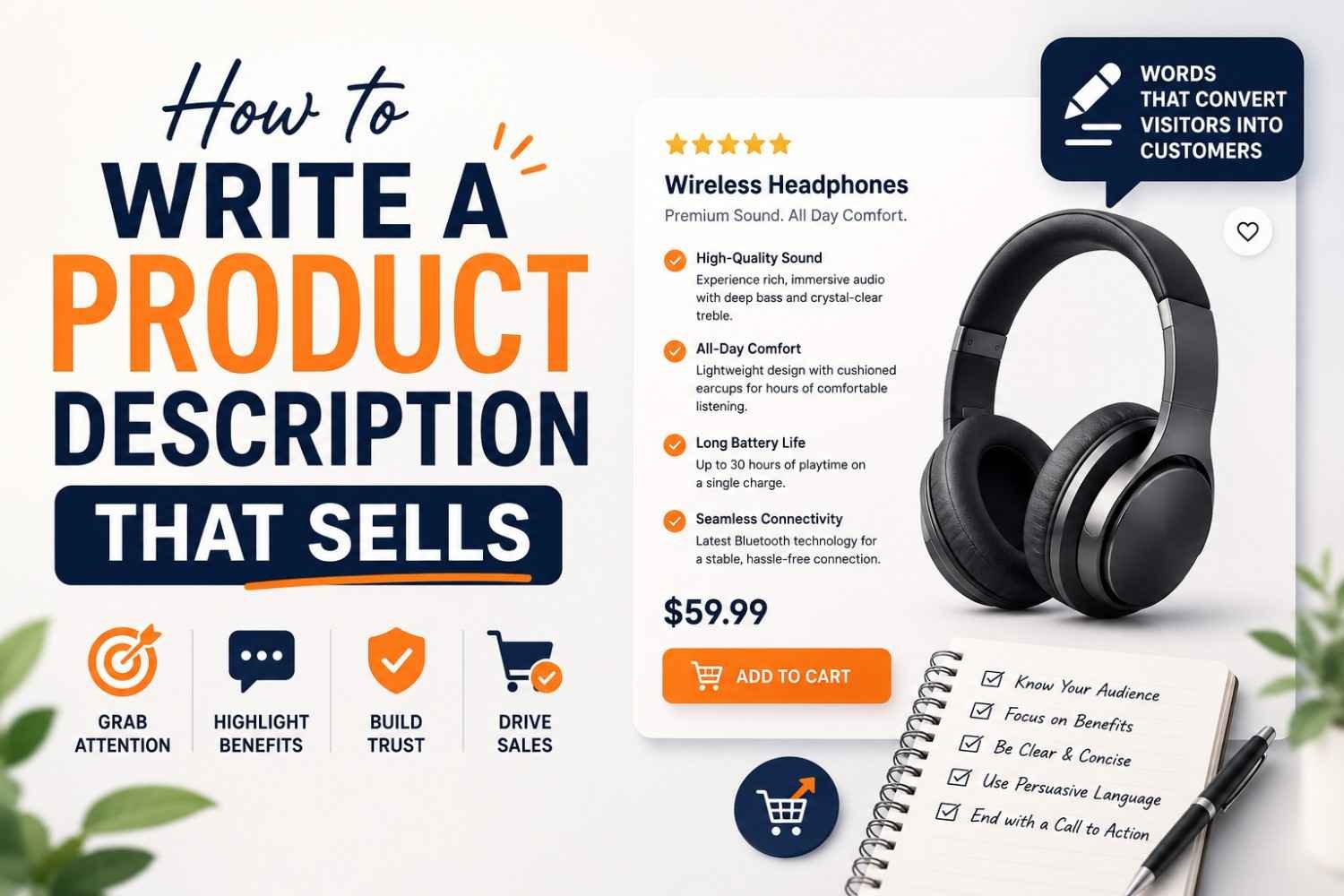
A product description has one job: turn a browser into a buyer. But most descriptions either read like a spec sheet or a keyword-stuffed mess — and neither one sells. Learning how to write a product description that actually converts is one of the highest-leverage skills any seller can develop.
This guide walks you through the process step by step, with before-and-after examples you can model from any niche. If you want the wider picture first, start with our e-commerce product SEO guide — this article goes deep on the description itself.
What Makes a Product Description Actually Sell?
A description that sells does three things at once: it speaks directly to the buyer, it communicates the product's value clearly, and it includes the right keywords so search engines can find it.
Most sellers only do one of these. They write for Google and forget the buyer. Or they write for the buyer and ignore SEO entirely. The best product descriptions do both — and they do it without the copy feeling forced.
✅ Speaks to what the buyer actually cares about (the benefit, not just the feature)
✅ Includes the primary keyword naturally in the first 50 words
✅ Uses specific, sensory detail that helps the buyer imagine owning it
❌ Doesn't list specs without context ("made of polyester" tells the buyer nothing)
❌ Doesn't copy the manufacturer's description — duplicate content hurts your rankings
How to Write a Product Description: Step by Step
Step 1: Know Who You're Writing For
Before you write a single word, get clear on your buyer. Who are they? What problem does this product solve for them? What would make them hesitate — and what would tip them over into buying?
A handmade soy candle sold to wellness buyers needs completely different language than the same candle sold as a home décor item. Same product. Different angle. Different description.
👉 Think about what your buyer types into the search bar — that's your keyword and your opening hook
👉 Look at your existing reviews — buyers describe products in their own words, and those words are gold
Step 2: Lead With the Benefit, Not the Feature
Features tell. Benefits sell. This is the most important shift in how you think about product copy.
❌ Feature-first: "This wallet is made from full-grain leather with a slim profile and three card slots."
✅ Benefit-first: "Carry everything you need without the bulk. This slim full-grain leather wallet fits three cards and your cash — and slips into your front pocket like it isn't there."
The second version answers the buyer's real question: what does this do for me? Work the feature in — but lead with what the buyer gets out of it.
Step 3: Use Your Keywords Naturally
Your primary keyword needs to appear in your description — but it has to read naturally. Forced keyword placement is easy to spot and it kills trust before the buyer even reads the full copy.
👉 Include your primary keyword in the first 50 words of the description
👉 Use secondary keywords and natural variations throughout — don't repeat the exact same phrase
✅ "handmade soy candle" → natural variations: "soy wax candle", "hand-poured candle", "natural candle"
❌ "This soy candle is the best soy candle for anyone looking for a soy candle gift" — stuffing kills conversion and rankings
Use Rankivo's Keyword Research Tool to find the exact phrases your buyers use and build a short keyword list before you start writing. For a full guide on using keywords without overdoing it, see our article on how to use keywords in product descriptions without stuffing.
Step 4: Add Sensory and Specific Detail
Vague descriptions don't convert. Specific, sensory detail does — because it helps the buyer visualise owning or using the product before they've bought it.
❌ "High-quality material" — means nothing
✅ "Heavyweight 400gsm cotton that holds its shape wash after wash" — specific and credible
❌ "Great for gifting" — overused and ignored
✅ "Comes gift-ready in a kraft box with a handwritten tag — no wrapping needed" — paints a picture
Think about texture, weight, smell, sound, size in context. What would the buyer notice first when they open the package? Write that.
Step 5: End With a Soft Call to Action
Don't just stop. A brief closing line that nudges the buyer forward — without being pushy — works better than an abrupt ending.
✅ "Order today and it ships within 24 hours."
✅ "Perfect for everyday carry — or as a gift they'll actually use."
❌ "BUY NOW BEFORE STOCK RUNS OUT!!!" — pressure tactics put buyers off
Before and After: Real Product Description Examples
Example 1: Handmade Leather Wallet
Before (feature-first, no hook):
"Brown leather wallet. Full grain leather. 3 card slots, 1 cash slot. Handmade. Slim design. Available in brown and black."
After (benefit-first, sensory, natural keyword):
"A handmade leather wallet built for people who hate carrying a brick in their pocket. Cut from full-grain leather that softens and darkens with age, this slim bifold holds three cards and your cash without adding bulk. Stitched by hand and built to last years, not months. Available in rich tan and classic black."
Example 2: Soy Wax Candle
Before:
"Lavender soy candle. 200g. Long burn time. Natural ingredients. Great for relaxing."
After:
"Wind down with a lavender soy candle that fills the room without overpowering it. Hand-poured using 100% natural soy wax and scented with pure lavender essential oil — no synthetic fragrance, no paraffin. A 200g jar gives you up to 45 hours of slow, clean burn. Light it after work and actually switch off."
How Long Should Your Product Description Be?
There's no universal answer — it depends on the platform and the product. For Google-indexed pages, aim for at least 150–300 words. For marketplace listings, use whatever space the platform gives you. Thin descriptions are one of the most common product SEO mistakes.
For the full breakdown by platform, read our guide on how long a product description should be for SEO.
Once you've written your description, run it through Rankivo's SEO Score Checker to catch keyword placement gaps, thin content, and missing meta tags before you publish.
📚 This Article Is Part of Our E-commerce Product SEO Series
Pillar: E-commerce Product SEO for Beginners: The Complete 2026 Guide
How to Write a Product Description That Sells (With Examples) ← You are here
Product Title SEO: How to Write Titles That Rank and Convert
Explore the full series to go deeper on any topic.
Frequently Asked Questions
What should a product description include?
At minimum: the primary benefit, the primary keyword, specific product details (material, size, weight, dimensions where relevant), sensory or emotional detail, and a soft closing line. Don't leave out the keyword — and don't lead with it either. Work it in naturally after the hook.
How do I write a product description for SEO?
Include your primary keyword in the first 50 words, use natural keyword variations throughout, write at least 150 words, and fill in your meta title and meta description separately. The copy should read naturally — not like it was written for a robot.
Can I use the same product description on multiple platforms?
You can, but it's not advisable. Duplicate descriptions across domains can dilute your Google rankings. Where possible, rewrite for each platform — even a meaningful variation helps each page rank independently.
Where can I find product description templates to start from?
We've put together a set of fill-in-the-blank structures across different product categories in our guide to product description templates for any niche.
Writing great product descriptions takes time — and doing it across a full catalogue takes even more. Rankivo's human writing team creates SEO-optimised product descriptions that convert, tailored to your platform, your product, and your buyer.
Ready to create content like this?
Use RANKIVO to generate SEO-optimized content in seconds. Start free today.
Start Free — No Credit Card