How to Use Keywords in Product Descriptions Without Stuffing
Learn how to place keywords in product descriptions naturally — without stuffing — so pages read well and still rank.
July 13, 2026
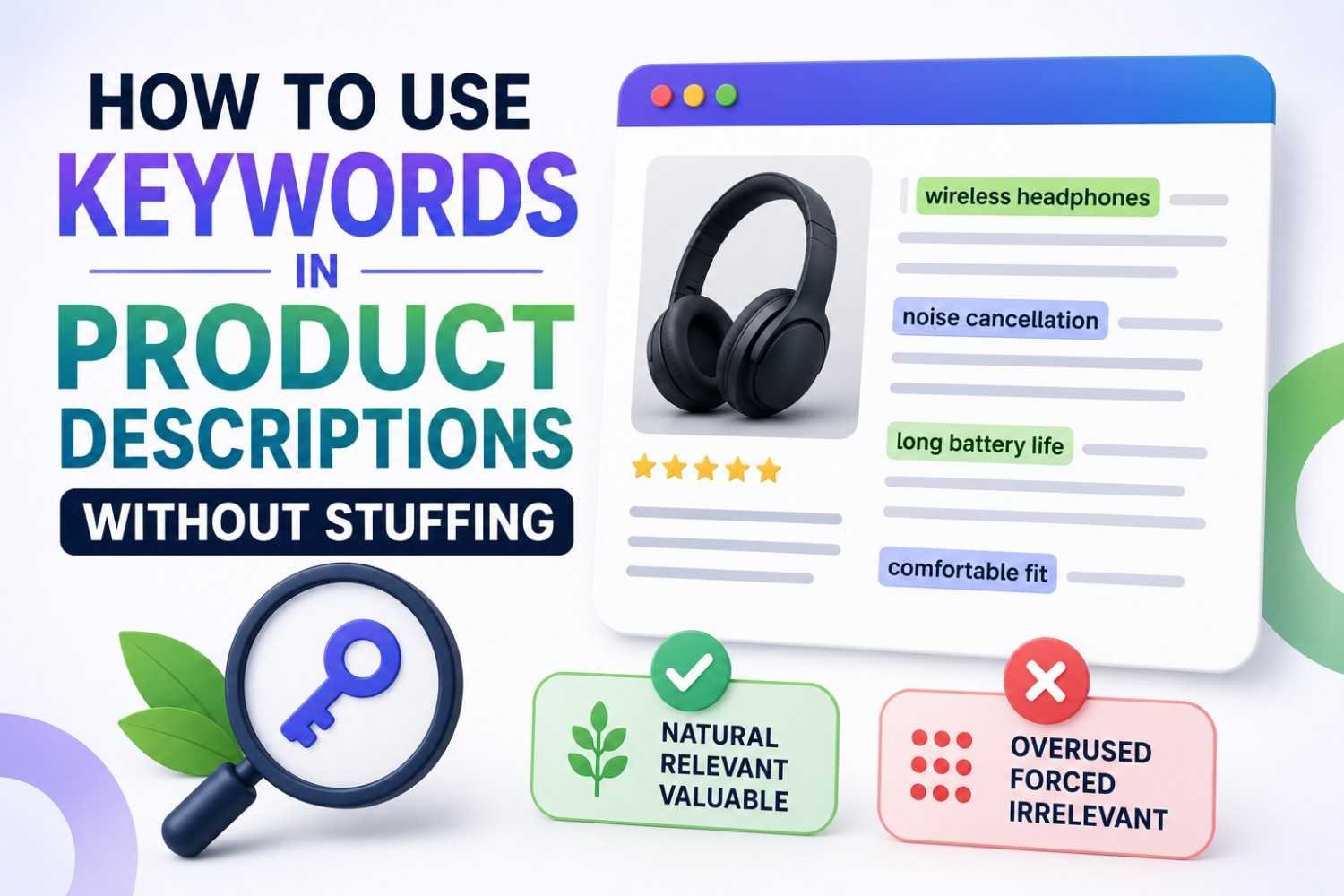
Getting product description keywords right is less about how many times you use a term and more about where and how naturally it appears. Overdo it, and the page reads like it was written for a search engine instead of a person — which hurts more than it helps.
Here's how to place keywords so they actually work.
Why Keyword Stuffing Backfires
Repeating the same phrase over and over used to be a shortcut to ranking. It isn't anymore. Modern search algorithms read for context and relevance, not raw keyword frequency — and buyers notice unnatural repetition just as much as search engines do.
- ❌ "This waterproof jacket is the best waterproof jacket for waterproof hiking"
- ✅ "This waterproof jacket is built for wet-weather hikes and holds up in heavy rain"
The second version says the same thing, reads naturally, and still includes the keyword where it matters.
Where Keywords Actually Belong
- 👉 In the first sentence or two, where both buyers and search engines look first
- 👉 In at least one subheading, if the description is long enough to have them
- 👉 Woven into a sentence describing a real feature or benefit — not standalone
One clear, natural placement near the top of the description usually does more work than five scattered repetitions further down.
Use Variations Instead of Repeating the Same Phrase
Search engines understand related terms, not just exact matches. This means you don't need to repeat "leather crossbody bag" four times — using natural variations covers more ground and reads better.
- ✅ "leather bag," "crossbody style," "everyday shoulder bag" — all reinforce the same topic
- ❌ Repeating the exact primary keyword in every sentence
Finding the secondary terms and related phrases people actually search for is where the Rankivo Keyword Research tool helps — it surfaces the natural variations worth weaving in, not just the one exact-match phrase.
A Simple Test for Overuse
Read the description out loud. If a keyword phrase feels repetitive or forced when spoken, it will read the same way to a buyer — and likely to a search engine too.
- ✅ One primary keyword mention near the top, used naturally
- ✅ A few related terms woven into supporting details
- ❌ The same exact phrase appearing three or more times in a short description
Conclusion
Good use of product description keywords is invisible to the reader — it just reads like a well-written, specific description. If a keyword placement calls attention to itself, it's probably doing more harm than good. For the complete framework on writing descriptions that rank and convert, see our guide on how to write a product description that sells.
FAQ
How many times should a keyword appear in a product description?
There's no fixed count. One natural mention near the beginning, plus a few related variations woven throughout, generally works better than repeating the exact phrase multiple times.
What's the difference between keyword stuffing and good keyword usage?
Good keyword usage reads naturally and fits the sentence it's in. Stuffing repeats the same phrase in a way that sounds forced or unnatural when read aloud — a strong sign it's been overused.
Should I use the exact keyword or variations?
A mix works best. Use the exact primary keyword once near the top, then rely on related terms and natural variations for the rest of the description.
Want to know which secondary keywords and variations are worth weaving into your descriptions?
Ready to create content like this?
Use RANKIVO to generate SEO-optimized content in seconds. Start free today.
Start Free — No Credit Card