Etsy SEO - How to Write Listings That Rank in 2026
Learn how Etsy SEO works in 2026, what the algorithm actually looks for, and how to write listings that rank higher and sell more — step by step.
July 5, 2026
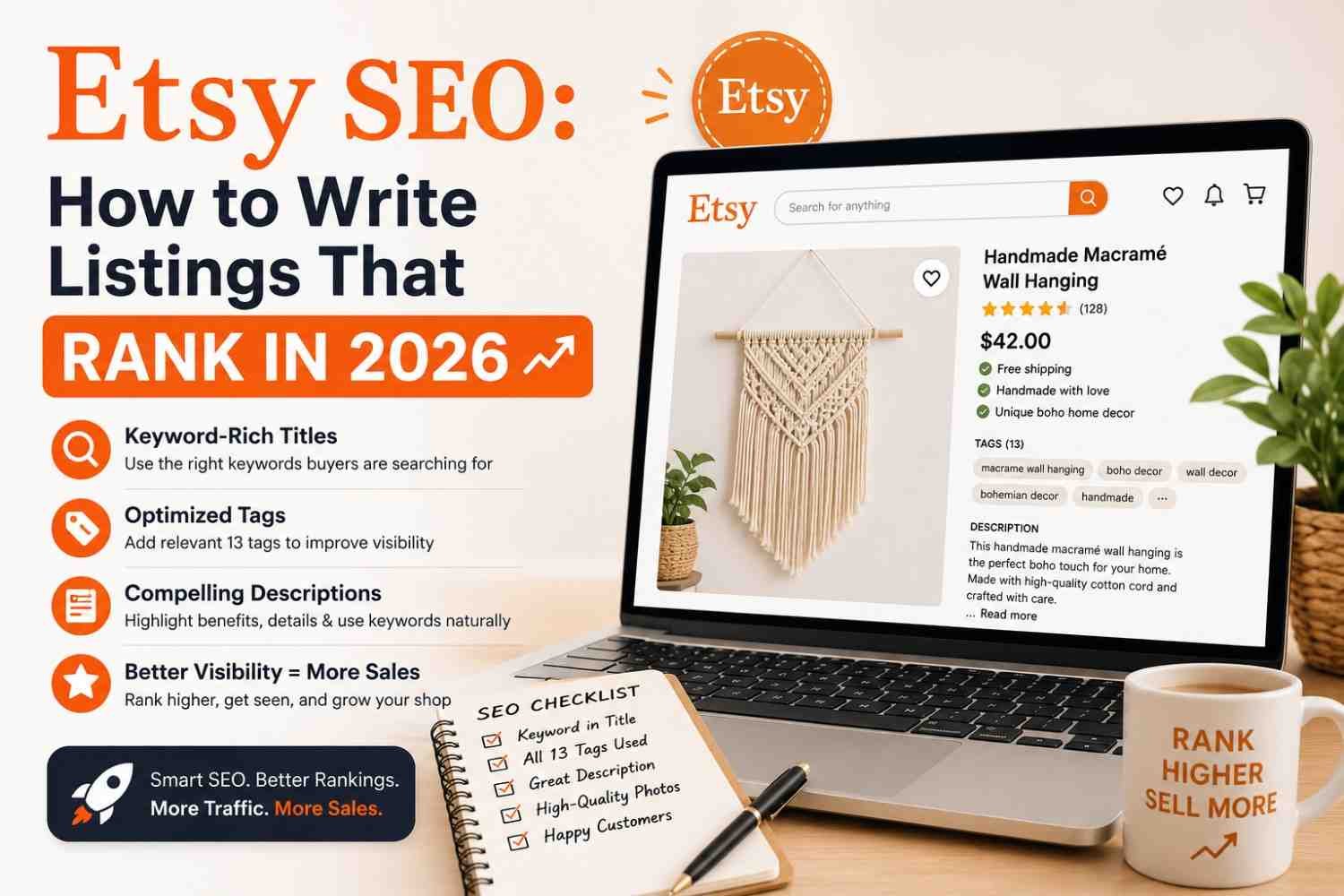
If your Etsy listings aren't showing up in search, it's not because your products aren't good enough. It's almost always an Etsy SEO problem. The good news is that Etsy SEO is learnable — and once you understand how the algorithm works, writing listings that rank becomes a straightforward process.
This guide covers exactly how Etsy's search algorithm works in 2026, what each part of your listing does, and how to optimise everything from your title to your tags. For the wider picture on product SEO across all platforms, start with our e-commerce product SEO guide.
How Etsy Search Works
Etsy's search algorithm ranks listings based on three main signals: keyword relevance, listing quality score, and context-specific ranking. Understanding each one tells you exactly where to focus your effort.
Keyword Relevance
Etsy matches buyer searches to listings by scanning your title, tags, categories, and attributes. The more precisely your listing matches a buyer's search phrase — not just individual words — the higher you rank. Etsy looks for exact phrase matches, not just keyword presence.
✅ "minimalist silver ring stacking set" matches that exact buyer search
❌ "ring silver minimalist beautiful" — the words are there but the phrase isn't
Listing Quality Score
Every Etsy listing has a quality score based on how buyers interact with it. When someone clicks your listing and then buys it, that sends a strong positive signal. When they click and leave, that's a negative one. Etsy uses this data to decide which listings deserve more visibility.
👉 A listing with great keywords but poor photos will rank, get clicked, and then lose ground as buyers bounce
👉 Rankings and conversion rate are directly linked — you can't optimise one and ignore the other
Recency and Renewals
New and recently renewed listings get a temporary ranking boost. This is Etsy's way of giving fresh listings a chance to prove themselves. It doesn't last long, but it means a newly published listing with solid SEO can jump to the top quickly.
How to Write an Etsy Listing That Ranks
Step 1: Find the Right Keywords First
Before you write a single word of your listing, you need to know what phrases buyers actually search for. Guessing doesn't work — most sellers either use terms that are too broad or phrases nobody actually types.
👉 Type your product into Etsy's search bar and look at the autocomplete suggestions — those are real buyer searches
👉 Look at the tags used by top-ranking listings in your category
👉 Focus on specific, multi-word phrases rather than single keywords
✅ "personalised leather bookmark gift for mum" is a buyer search — "leather bookmark" alone is too broad
Rankivo's Keyword Research Tool helps you find the exact phrases buyers use with difficulty scores and search intent data — so you're not just guessing what to put in your tags. For a full walkthrough of finding and using Etsy keywords, read our guide on how to find and use Etsy SEO keywords in 2026.
Step 2: Write Your Title for Etsy Search, Not for Humans
Etsy listing titles work differently from product titles on your own website. On Etsy, the title is primarily a keyword field — buyers rarely read the full title before clicking the photo. That means you should load it with the key phrases buyers search for.
👉 Put your most important keyword phrase at the very start of the title
👉 Use commas or hyphens to separate distinct keyword phrases
✅ "Personalised Leather Bookmark — Custom Name Bookmark, Gift for Mum, Reader Gift, Book Lover Gift"
❌ "Beautiful Handmade Bookmark You'll Treasure Forever" — no searchable phrases, ranks for nothing
👉 Aim to use 120–140 of the 140 characters available
Step 3: Use All 13 Tags — Every Single One
Etsy gives you 13 tags per listing. Each tag can be up to 20 characters. Every unused tag is a ranking opportunity you've thrown away. Most sellers leave two or three empty — and those empty slots cost real visibility.
✅ Use all 13 tags, every time, no exceptions
✅ Each tag should be a phrase a buyer would actually search — not a single word
✅ Use different phrases across your tags to cover more search variations
❌ Don't repeat phrases already used in your title — Etsy already indexes your title, so it's wasted space
❌ Don't use single-word tags like "leather" or "gift" — they're too broad to convert
Tags and titles work together, but they're not the same. For a clear breakdown of which one carries more weight and how to use both correctly, read our article on Etsy tags vs titles: what actually helps you rank.
Step 4: Write a Description That Converts
Etsy's algorithm doesn't heavily index your description for ranking — but your buyers read it. And since listing quality score is driven by conversion rate, a description that turns browsers into buyers directly improves your rankings over time.
👉 Lead with the most important detail — what it is, who it's for, why it's special
👉 Include your primary keyword in the first sentence naturally
👉 Address the most common buyer questions: dimensions, materials, personalisation options, delivery times
✅ Break the description into short paragraphs — walls of text put buyers off
❌ Don't just copy your title into the description — it adds no value to the buyer
Step 5: Fill in Attributes and Categories Properly
Attributes — the structured fields Etsy provides for things like colour, material, occasion, and style — are used by Etsy's algorithm for filtered searches. A buyer who filters by "silver" and "minimalist" will only see listings with those attributes filled in correctly.
👉 Fill in every attribute field that applies to your product
👉 Choose the most specific subcategory available — it narrows competition and improves relevance
✅ A listing in "Necklaces → Pendant Necklaces → Birthstone Necklaces" will rank better for birthstone searches than one in "Jewellery"
What Hurts Your Etsy SEO Without You Knowing
❌ Using the same tags across multiple listings — Etsy sees this as you competing with yourself
❌ Changing your title and tags too frequently — the algorithm needs time to measure your listing quality
❌ Poor quality photos — low click-through rate damages your listing quality score even if your keywords are perfect
❌ Pricing significantly above comparable listings — it suppresses conversion rate, which suppresses rankings
❌ Ignoring your shop stats — Etsy shows you exactly which searches bring buyers to your shop; use that data
How Long Does Etsy SEO Take to Work?
Most Etsy sellers expect overnight results and give up too early. In reality, a newly optimised or renewed listing needs time for Etsy to gather click and conversion data before it can rank consistently.
👉 Give a new or updated listing at least 4–6 weeks before judging its performance
👉 Make one change at a time so you can track what's actually working
✅ Listings that convert well after the initial boost period get promoted further by Etsy — the algorithm rewards patience
Once your listings are optimised, run them through Rankivo's SEO Score Checker to catch any gaps in keyword placement, description quality, or meta fields before you publish.
📚 This Article Is Part of Our E-commerce Product SEO Series
Pillar: E-commerce Product SEO for Beginners: The Complete 2026 Guide
How to Write a Product Description That Sells (With Examples)
Etsy SEO: How to Write Listings That Rank in 2026 ← You are here
Product Title SEO: How to Write Titles That Rank and Convert
Explore the full series to go deeper on any topic.
Frequently Asked Questions
What is the most important part of Etsy SEO?
Your title and tags together. They're the primary signals Etsy uses to match your listing to buyer searches. Both need to contain the exact multi-word phrases buyers type — not single keywords or creative descriptions that don't match real searches.
Should I use the same keywords in my Etsy title and tags?
For your single most important keyword phrase, yes — repeat it in both. For everything else, use different phrases in your tags to cover more search variations. Etsy already indexes your title, so filling all 13 tags with title repeats is wasted space.
How many tags should I use on Etsy?
All 13, every time. Etsy gives you 13 tag slots and each one is a potential ranking opportunity. Leaving any blank is leaving visibility on the table for no reason.
Does renewing a listing help with Etsy SEO?
It gives a short-term visibility boost, but it's not a long-term strategy. Renewing resets the recency signal, which temporarily improves placement — but without strong keywords and a good listing quality score, that boost fades quickly. Focus on fundamentals first.
Getting your Etsy listings to rank takes the right keywords, the right structure, and copy that converts browsers into buyers. Rankivo's human writing team creates fully optimised Etsy listing descriptions tailored to your products and your buyers.
Ready to create content like this?
Use RANKIVO to generate SEO-optimized content in seconds. Start free today.
Start Free — No Credit Card