What Is Anchor Text and How to Use It for SEO
Anchor text tells search engines what a linked page is about. Learn the different types, which ones help SEO, and the mistakes that can get you penalised.
June 28, 2026
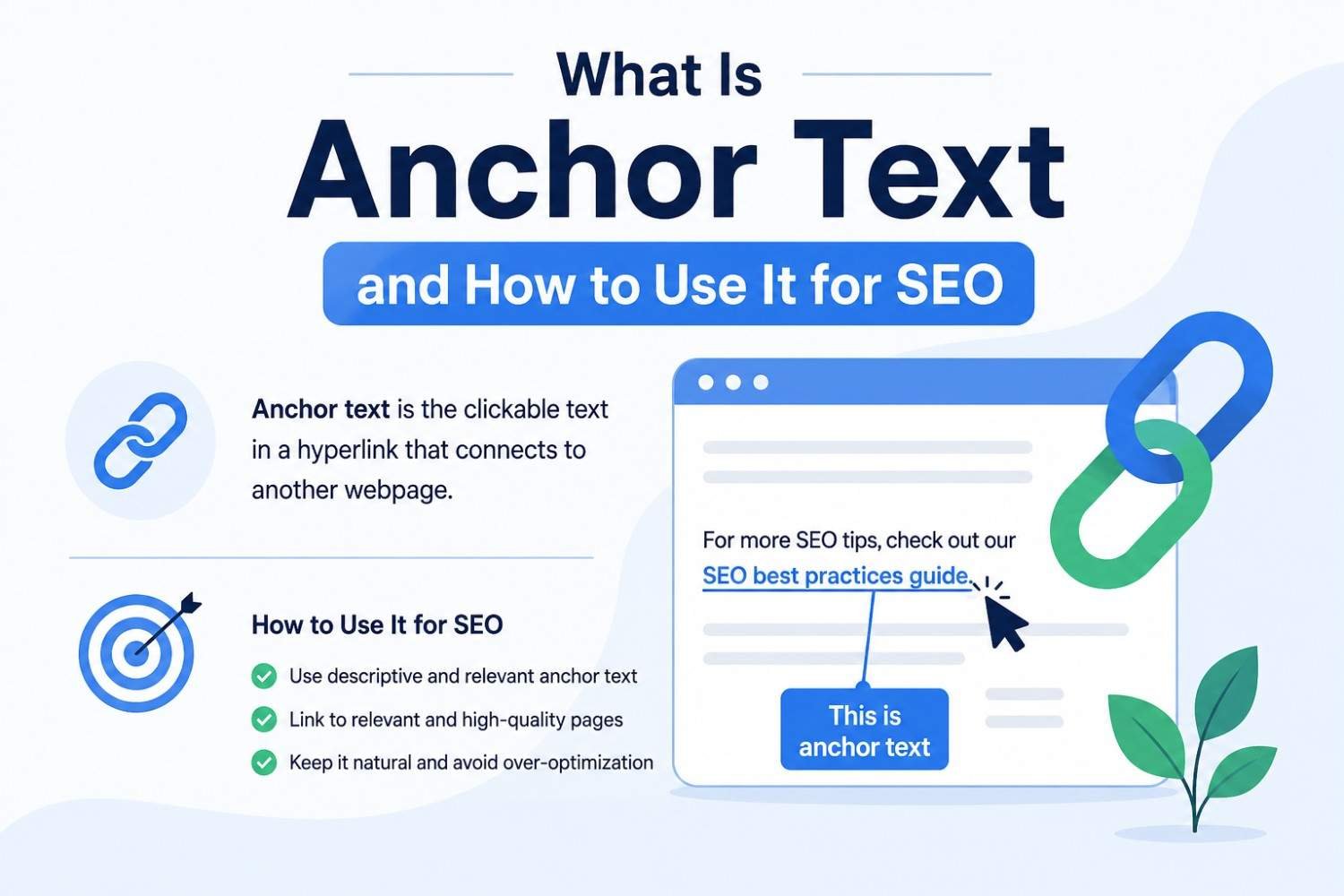
Every link on a webpage has two parts: the URL it points to, and the visible, clickable text. That clickable text is called anchor text.
It sounds like a small detail. But anchor text is one of the clearest signals you can send to search engines about what a linked page covers — and using it badly is one of the easiest ways to quietly damage your SEO.
What Is Anchor Text?
Anchor text is the words a reader sees and clicks when following a hyperlink.
For example, if a sentence reads: "Learn the fundamentals in our on-page SEO guide for beginners" — the anchor text is "on-page SEO guide for beginners." The URL behind it is invisible to the reader but carried to the search engine.
Search engines use anchor text to understand the topic and relevance of the destination page. If dozens of pages link to a URL using the anchor text "keyword research tool," search engines take that as a strong signal that the destination page is about keyword research tools.
That signal works for internal links too — not just backlinks.
The Main Types of Anchor Text
Exact match — The anchor text is the exact keyword you want the destination page to rank for. Example: "keyword density SEO." Powerful when used sparingly. Overuse triggers over-optimisation penalties.
Partial match — Includes the target keyword but with extra words around it. Example: "understanding keyword density for SEO." More natural. Generally safer than exact match at scale.
Branded — Uses your brand name as the anchor. Example: "Rankivo's SEO Score Checker." Builds brand authority and looks natural to search engines.
Naked URL — The raw URL is used as the link text. Example: "rankivo.co/tools/seo-score-checker." Acceptable occasionally but not informative for either readers or search engines.
Generic — Non-descriptive phrases like "click here," "read more," or "this article." These pass no keyword signal and waste the opportunity. Avoid them.
Topical/descriptive — Anchor text that describes the destination page's topic without matching an exact keyword. Example: "a guide to writing better meta descriptions." This is the safest, most natural type for internal linking.
How Anchor Text Affects SEO
For internal links, anchor text helps search engines build a map of your site's content. Descriptive, relevant anchor text tells Google which of your pages covers which topics — reinforcing your topical authority across the whole site.
For backlinks, anchor text from external sites carries significant ranking weight. A backlink with relevant anchor text is more valuable than one with generic text — but an unnatural pattern of exact-match anchors pointing to the same page from many sites is a well-known spam signal.
The key difference: internal links are under your control, so you can be more deliberate with them. External links you earn naturally tend to produce a healthy variety of anchor text without you needing to engineer it.
Anchor Text Best Practices for Internal Links
✅ Use descriptive anchors — Every internal link should tell the reader (and search engine) what they will find on the other side. "Internal linking for SEO" is better than "this article." "How to write a meta description" is better than "read more."
✅ Vary your anchors for the same destination — If you link to a page multiple times across your site, use slightly different anchor text each time. This looks natural and covers more keyword variations.
❌ Avoid over-optimising — Do not link to the same page using the exact same keyword-rich anchor text from every article. Vary it. Mix exact, partial, branded, and topical anchors.
✅ Keep it relevant to the surrounding text — Anchor text should feel like a natural continuation of the sentence it sits in. If it reads awkwardly, rewrite the sentence, not just the anchor.
Rankivo's SEO Score Checker flags internal linking issues in your content — including generic anchors and missing links — so you can tighten up your link structure before publishing.
The One Anchor Text Mistake to Stop Making
The most common anchor text mistake is not over-optimisation. It is using "click here."
"Click here" tells search engines nothing. It tells readers nothing about what they are clicking to. It is a wasted link every single time.
Replace every "click here" with a short, descriptive phrase that explains the destination. That one habit alone will improve your internal linking SEO across your entire site.
The Takeaway
Anchor text is a small element with a significant SEO impact. Use descriptive, varied anchors for internal links. Keep external anchor patterns natural. Avoid generic phrases that pass no signal.
Done well, anchor text reinforces your topical authority, helps individual pages rank, and makes your content more useful for readers — all at the same time.
This Article Is Part of Our On-Page SEO Series
📚 Explore the full Keyword Research Series
Start here:
Pillar article:
👉 On-Page SEO for Beginners: The Complete 2026 Guide
Parent cluster article:
👉 Internal Linking for SEO: A Beginner's Guide
Other articles in this group:
What Is Anchor Text and How to Use It for SEO ← You are here
Explore the full series to go deeper on any topic.
FAQ
What is anchor text in SEO?
Anchor text is the visible, clickable words in a hyperlink. Search engines use it to understand what the linked page is about, making it an important on-page and off-page SEO signal.
What type of anchor text is best for SEO?
Descriptive and partial-match anchors are generally safest and most effective for internal links. Exact-match anchors work well in moderation but can trigger penalties if overused across many links.
Does anchor text matter for internal links?
Yes. Internal link anchor text helps search engines map your site's content and reinforces which pages cover which topics. Descriptive internal anchors are one of the easiest on-page wins available.
What is an exact match anchor text?
An exact match anchor is when the clickable link text is the precise keyword you want the destination page to rank for. It carries strong SEO signal but should be used sparingly to avoid over-optimisation.
Should I avoid generic anchor text like "click here"?
Yes. Generic anchors pass no keyword signal to search engines and give readers no context about the destination. Always replace them with a short, descriptive phrase.
Want to catch weak anchor text and missing internal links before you publish? Rankivo's SEO Score Checker reviews your content's link structure and flags what needs fixing — in seconds. Start free at www.rankivo.co.
Ready to create content like this?
Use RANKIVO to generate SEO-optimized content in seconds. Start free today.
Start Free — No Credit Card