How Many Internal Links Per Page Is Ideal for SEO?
Too few internal links waste SEO potential. Too many dilute it. Find out how many internal links per page is actually ideal — and how to place them.
June 28, 2026
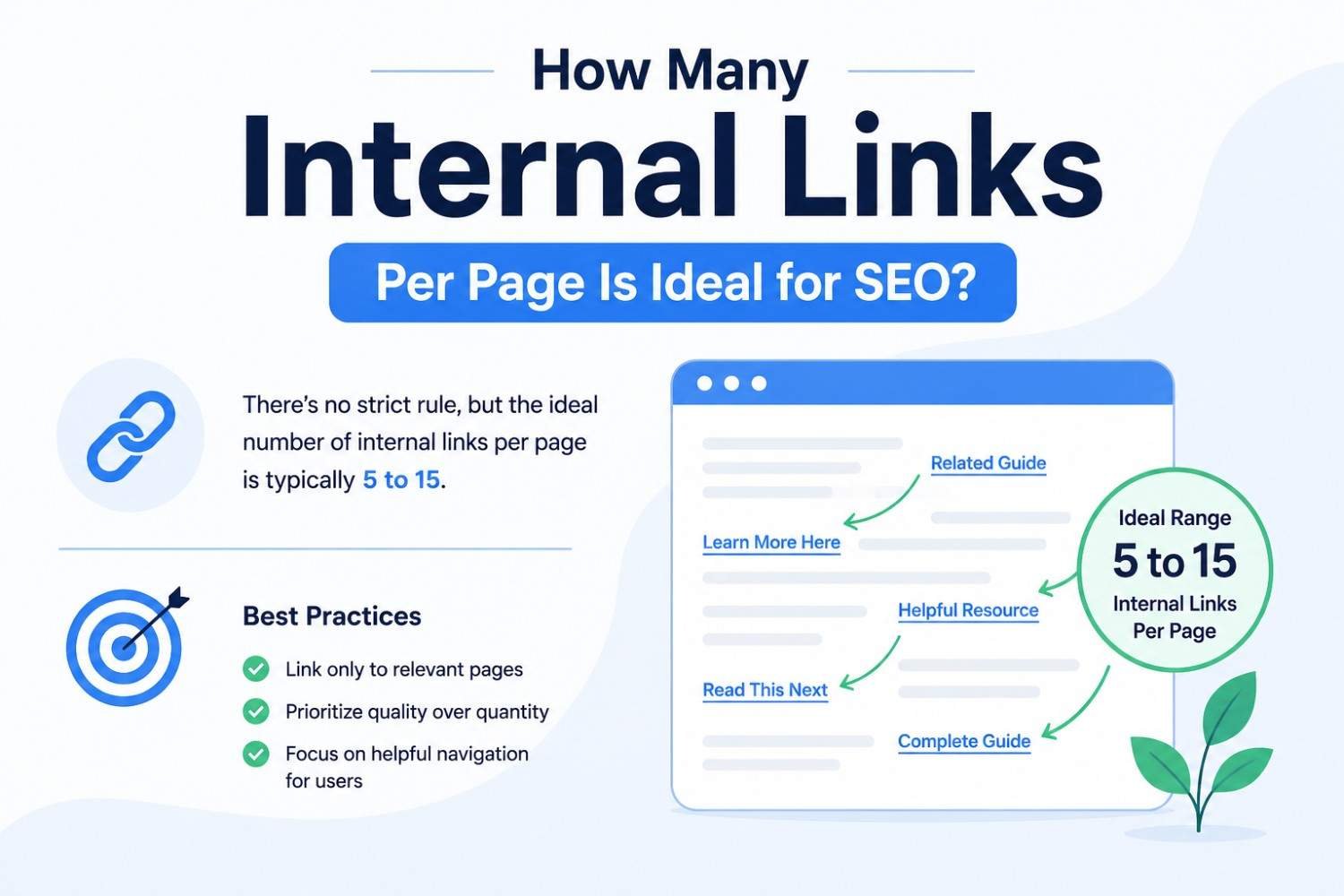
You know internal linking matters. But once you start adding links, a new question shows up fast: how many is too many — or too few?
Add too few, and you waste the chance to guide both readers and search engines deeper into your site. Add too many, and each link carries less weight, while the page starts to feel cluttered.
Here's how to find the right number.
There Is No Fixed Number — But There Is a Range
Google has never published an exact limit on internal links per page. What it has said is that links should be reasonable in number and genuinely useful to users.
That said, most SEO practitioners work within a practical range based on real-world testing and observation:
For a typical blog post (800–1,500 words): 3 to 5 internal links is a solid baseline.
For longer pillar or guide content (2,000+ words): 7 to 10 internal links is reasonable, since there's more content to support natural linking opportunities.
For short pages (under 600 words): 1 to 3 internal links is usually enough — forcing more than that often feels unnatural.
These are starting points, not hard caps. The right number depends far more on whether each link adds value than on hitting a specific count.
Why Too Few Internal Links Hurts You
If a page has zero or one internal links, you're missing out in a few ways.
❌ You're not passing any authority to other pages on your site. Internal links help distribute ranking signals from your stronger pages to newer or weaker ones.
❌ You're giving search engine crawlers fewer paths to discover your other content. Pages with no internal links pointing to them can take longer to get indexed — or may not get indexed efficiently at all.
❌ You're leaving the reader with nowhere to go. If someone finishes reading and has no relevant next step, they leave your site instead of exploring further.
Why Too Many Internal Links Hurts You
On the other end, cramming in 15+ internal links into a single article causes its own problems.
❌ Each link dilutes the ranking signal passed to its destination. If a page links to 20 other pages, the "vote" each one receives is smaller than if it linked to 5.
❌ It also creates a poor reading experience. A paragraph with five links in three sentences looks spammy and pulls focus away from the actual content.
❌ From a crawl perspective, excessive linking can make it harder for search engines to identify which links on the page actually matter most.
Where to Place Internal Links for Maximum Impact
Placement matters as much as count.
✅ Early in the content — A link within the first few paragraphs tends to carry more weight than one buried at the bottom, since it signals relevance early.
✅ Within relevant context — Link from a sentence that's actually about the topic of the destination page. A link to your meta description guide should appear in a sentence discussing meta descriptions — not randomly dropped into an unrelated paragraph.
❌ Avoid clustering — Spread links throughout the article rather than stacking several in one paragraph or section.
✅ In the cluster navigation block — If you're using a content cluster structure, the dedicated linking section at the end of the article is a natural, expected place for additional relevant links.
How to Audit Your Internal Linking
If you're unsure whether your existing content has the right balance, start by reviewing your most important pages — your pillar articles and highest-traffic posts.
Check: Does each one link out to enough relevant pages? Are any high-value pages receiving few or no internal links? Are any pages over-linked to the point of looking cluttered?
Rankivo's SEO Score Checker reviews your content's internal link count and placement as part of its overall analysis — making it easy to spot pages that are under-linked or over-linked at a glance.
The Takeaway
For most blog posts, 3 to 5 well-placed internal links is the sweet spot. Longer pillar content can support more — 7 to 10 — while short pages need fewer.
The number matters less than the quality of each link. Every internal link should genuinely help the reader go somewhere useful next. If it does that, you're doing internal linking for SEO correctly — regardless of the exact count.
This Article Is Part of Our On-Page SEO Series
📚 Explore the full Keyword Research Series
Start here:
Pillar article:
👉 On-Page SEO for Beginners: The Complete 2026 Guide
Parent cluster article:
👉 Internal Linking for SEO: A Beginner's Guide
Other articles in this group:
How Many Internal Links Per Page Is Ideal for SEO? ← You are here
Explore the full series to go deeper on any topic.
FAQ
How many internal links should a blog post have?
For a typical 800–1,500 word post, 3 to 5 internal links is a solid baseline. Longer pillar content can support 7 to 10, while shorter pages need fewer.
Can too many internal links hurt SEO?
Yes. Excessive internal linking dilutes the ranking signal passed to each destination page and can create a cluttered, spammy reading experience.
Does Google have a maximum internal link limit?
No official limit exists. Google recommends links be reasonable in number and useful to users, rather than specifying an exact maximum.
Where should internal links be placed for the best SEO impact?
Early in the content and within contextually relevant sentences. Links placed near the top of an article and surrounded by related text tend to carry more weight.
How do I check if my internal linking is balanced?
Review your key pages for link count and relevance, or use a tool like Rankivo's SEO Score Checker, which flags under-linked and over-linked content automatically.
Want to know if your internal linking is helping or hurting your SEO? Rankivo's SEO Score Checker analyses your content's link structure and gives you clear, actionable feedback. Start free at www.rankivo.co.
Ready to create content like this?
Use RANKIVO to generate SEO-optimized content in seconds. Start free today.
Start Free — No Credit Card