Short URLs vs Long URLs - Which Is Better for SEO?
Does URL length affect rankings? Here's what the evidence actually shows about short vs long URLs — and how to decide the right length for your pages.
June 28, 2026
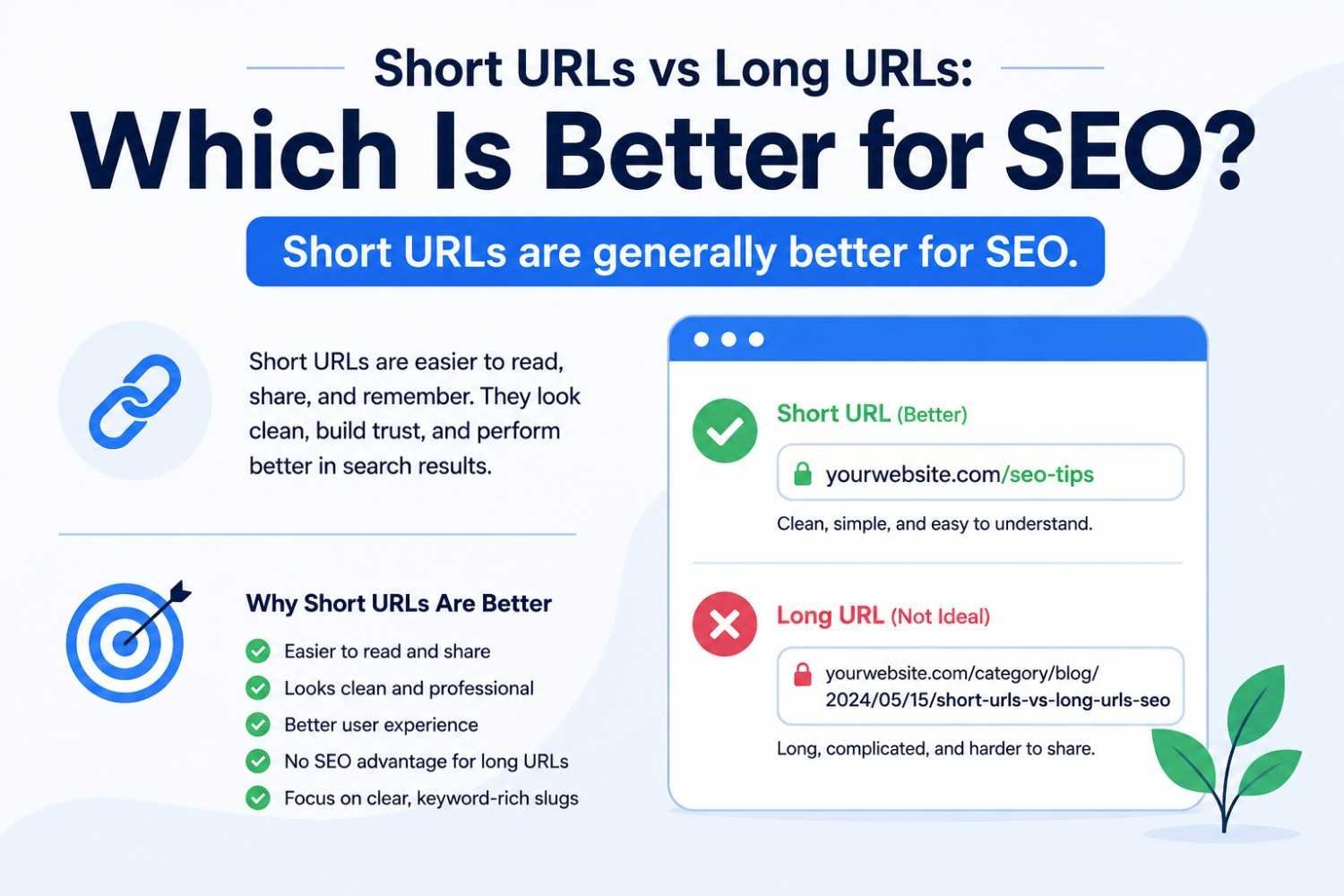
You've probably seen the advice: "keep your URLs short for SEO." But is URL length actually a ranking factor — or is this one of those SEO myths that gets repeated without evidence?
The honest answer sits in between. Length itself isn't the real factor. What's inside the URL is.
Does URL Length Directly Affect Rankings?
Google has stated that URL length itself is not a significant ranking factor. A URL with 80 characters doesn't rank worse than one with 40 characters purely because of its length.
However, studies analysing large sets of search results have repeatedly found that shorter URLs tend to correlate with higher rankings. This has led to a lot of confusion — does correlation mean causation here?
Mostly, no. Shorter URLs tend to rank well not because they're short, but because of what shortness usually represents: a clear, focused topic, a clean site structure, and a URL that wasn't auto-generated with unnecessary parameters.
In other words, short URLs are often a symptom of good SEO practice — not the cause of good rankings.
What Long URLs Usually Get Wrong
Long URLs aren't a problem because of character count. They're a problem because of what tends to make them long:
❌ Unnecessary words — URLs like
/blog/2026/01/15/the-ultimate-complete-guide-to-everything-you-need-to-know-about-seocarry far more words than needed to convey the topic.❌ Stop words and filler — Words like "the," "and," "for," "a," "of" add length without adding clarity.
/blog/guide-to-the-best-seo-tools-for-bloggers-in-2026could become/blog/best-seo-tools-bloggers-2026.❌ Dates and version numbers — Including a publish date in the URL can make content look outdated even after you update it, and it adds length without helping the reader understand the topic.
❌ Auto-generated parameters — URLs with strings like
?id=4821&ref=sidebar&session=xyzare long, unreadable, and provide no topical signal at all.
A long URL caused by any of these is a problem. A long URL because the keyword phrase itself is naturally longer is generally fine.
What Short URLs Get Right
A well-structured short URL usually has these traits:
✅ It reflects the page's primary keyword directly —
/blog/keyword-density-seoimmediately tells you (and search engines) what the page is about.✅ It avoids unnecessary words — Every word in the URL earns its place.
✅ It's easy to read and remember — A reader glancing at the URL in a search result or browser tab can understand what the page covers.
✅ It's stable — Short, keyword-focused URLs are less likely to need changing later, which avoids redirect chains down the line.
So Which Should You Choose?
The goal isn't "short" or "long" — it's "clear and necessary."
If your primary keyword is naturally short (e.g., "alt text SEO"), your URL should be short too: /blog/alt-text-seo.
If your primary keyword is naturally longer (e.g., "how long should a blog post be for SEO"), a slightly longer URL is fine — but you can still trim filler words: /blog/how-long-should-a-blog-post-be-for-seo rather than adding extra connecting words on top of that.
As a practical guideline: most well-optimised URLs fall between 3 and 6 words after the domain and folder structure. If you're consistently going beyond that, look for words you can cut — not because of a length rule, but because those words usually aren't adding value.
A Quick URL Audit Checklist
Before publishing, check your URL against these questions:
✅ Does it include your primary keyword?
✅ Have you removed stop words where possible (the, and, for, of, a)?
✅ Is it free of dates, version numbers, and tracking parameters?
✅ Could someone guess what the page is about just from reading the URL?
If you answer yes to all four, your URL length — whatever it is — is doing its job.
Rankivo's SEO Score Checker reviews your overall page setup, including URL and keyword alignment, as part of its full on-page analysis — helping you catch structural issues like this before you publish.
The Takeaway
Short URL vs long URL for SEO isn't really the right framing. The real question is whether your URL is clear, keyword-relevant, and free of unnecessary clutter.
Trim what doesn't need to be there. Keep what conveys the topic. The resulting length — short or slightly longer — will take care of itself.
This Article Is Part of Our On-Page SEO Series
📚 Explore the full Keyword Research Series
Start here:
Pillar article:
👉 On-Page SEO for Beginners: The Complete 2026 Guide
Parent cluster article:
👉 URL Structure for SEO: How to Create URLs That Rank
Other articles in this group:
👉 Short URLs vs Long URLs: Which Is Better for SEO? ← You are here
Explore the full series to go deeper on any topic.
FAQ
Is URL length a Google ranking factor?
Not directly. Google has said URL length itself doesn't significantly affect rankings. Shorter URLs tend to correlate with better rankings because they're usually a sign of clear, well-structured pages — not because of length itself.
How long should a URL be for SEO?
Most well-optimised URLs fall between 3 and 6 words after the domain. The exact number matters less than whether every word in the URL is necessary and reflects the page's topic.
Should I include dates in my URL?
Generally, no. Dates can make evergreen content look outdated and add unnecessary length. Keep dates out unless the content is genuinely time-specific.
Do stop words in URLs hurt SEO?
They don't cause penalties, but removing words like "the," "and," and "for" makes URLs cleaner and easier to read, without losing meaning.
What's more important — short URLs or keyword-rich URLs?
Keyword relevance matters more. A URL that clearly reflects the page's primary keyword is more valuable than one that's simply short but vague.
Want to make sure your URLs, headings, and keyword placement are all working together? Rankivo's SEO Score Checker reviews your full page setup in one pass. Start free at www.rankivo.co.
Ready to create content like this?
Use RANKIVO to generate SEO-optimized content in seconds. Start free today.
Start Free — No Credit Card