On-Page SEO Checklist for Beginners (2026)
A simple, practical on-page SEO checklist covering titles, meta tags, headings, content, links, URLs, and images — everything to check before you publish.
June 29, 2026
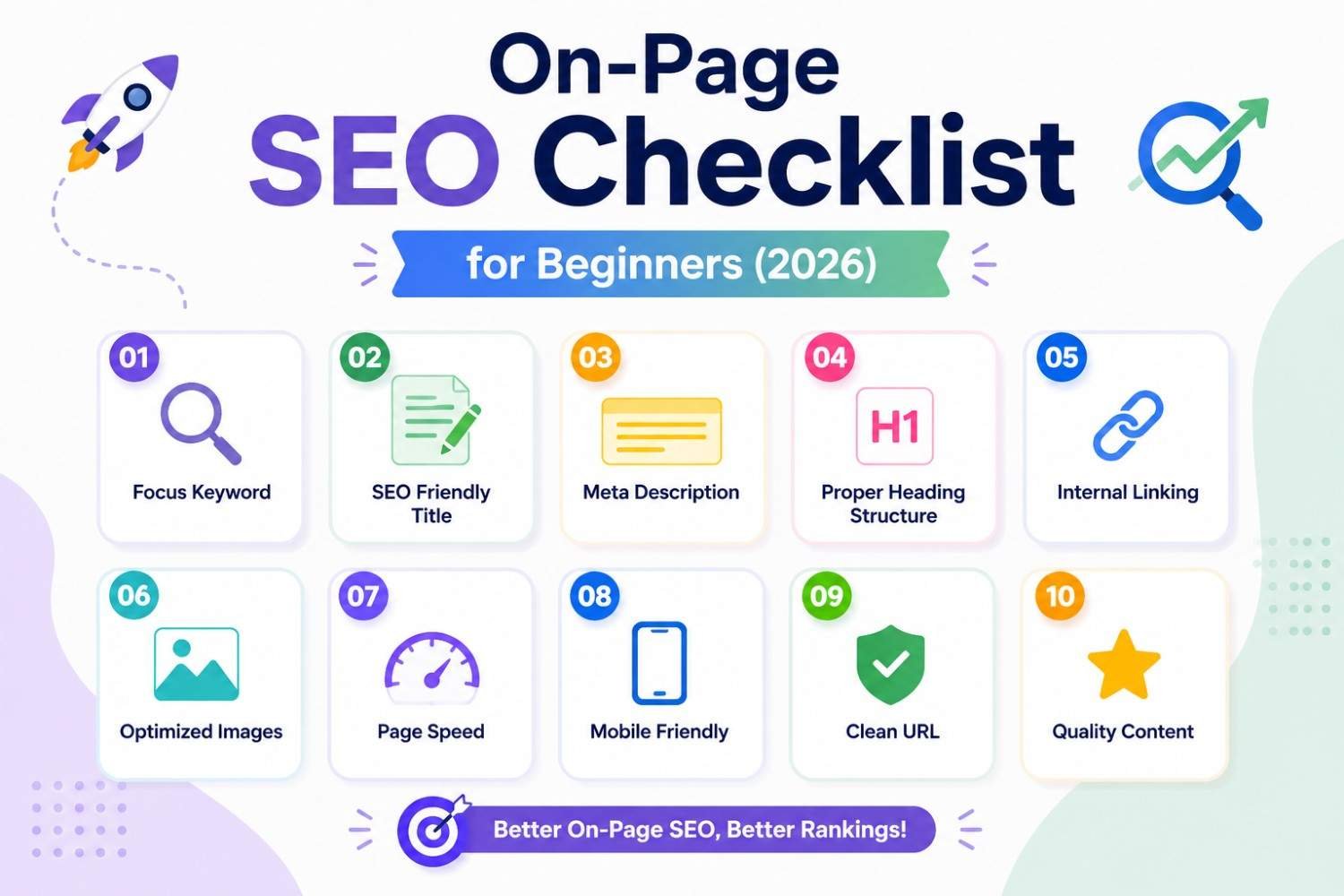
You've written your post. Before you hit publish, there's one more step that makes a real difference: a quick on-page SEO pass.
This isn't about overthinking every sentence. It's a short list of checks that take a few minutes but consistently separate posts that rank from posts that quietly disappear.
Here's the full checklist, broken down by section.
Title and Meta Tags
✅ Primary keyword appears in your title — Ideally near the beginning, in a natural-sounding phrase.
✅ Title is the right length — Roughly 50–60 characters so it doesn't get cut off in search results.
✅ Meta description is written — Not left blank for Google to auto-generate. Aim for 150–160 characters.
✅ Meta description includes the keyword and a reason to click — A clear benefit or answer, not just a restatement of the title.
Headings and Structure
✅ One clear H1 — Matching or closely related to your title, used only once.
✅ Logical H2s breaking up major sections — Each one should reflect a sub-topic a reader might search for separately.
✅ H3s used for sub-points within H2 sections — Not skipped levels (no H3 directly under an H1 with no H2 in between).
✅ Headings describe content accurately — A reader skimming just the headings should understand the article's structure.
Content and Keywords
✅ Primary keyword in the first paragraph — Ideally within the first 100 words.
✅ Primary keyword in at least one H2 — Naturally, not forced.
✅ Primary keyword in the conclusion — Reinforces the topic without repeating the exact same sentence as the intro.
✅ Keyword density feels natural — Roughly 1–2%, with related terms and synonyms used throughout rather than one phrase repeated mechanically.
✅ Content matches search intent — The article actually answers what someone searching this keyword wants to know, completely.
✅ Paragraphs are short — 2 to 4 lines, easy to scan on mobile.
Internal Linking
✅ 3–5 internal links for a standard post — More for longer pillar content, fewer for short pages.
✅ Anchor text is descriptive — No "click here" or "read more." Each link tells the reader what they'll find.
✅ Links point to genuinely relevant pages — Not just added to hit a number.
✅ Cluster navigation block included — If part of a content cluster, links to the pillar and related cluster articles are present.
URL and Slug
✅ URL includes the primary keyword — Closely matching, without unnecessary extra words.
✅ Slug is lowercase with hyphens — Not underscores, not mixed case.
❌ No unnecessary dates, numbers, or parameters — Unless the content is genuinely time-specific.
✅ URL is readable — Someone could guess the topic just by glancing at it.
Images
✅ Every informative image has alt text — Concise, accurate, 5–15 words.
✅ Decorative images have empty alt attributes — So screen readers skip them appropriately.
✅ Images are compressed — Large file sizes slow down page load, which affects both user experience and rankings.
❌ File names are not generic strings — Avoid names like
IMG_4821.jpg; use descriptive file names instead.
Final Read-Through
✅ Read it as if you're the searcher — Does it actually solve their problem, start to finish?
❌ No padding or filler sections — Every section earns its place.
❌ No competitor names or off-brand mentions — If applicable to your content guidelines.
✅ Formatting is clean — No broken lists, inconsistent heading styles, or leftover placeholder text.
Run It Through a Tool Before You Publish
Going through this list manually takes maybe 10–15 minutes for a typical post. But it's easy to miss something — especially keyword placement details or a missing alt text on one image out of ten.
Rankivo's SEO Score Checker runs through most of this checklist automatically. Paste in your content and target keyword, and it flags exactly what's missing — title length, keyword placement, heading structure, internal links, and image optimization — all in one pass.
It won't replace good writing. But it catches the small, easy-to-miss details that this checklist covers, in a fraction of the time.
How This Fits Into the Bigger Picture
Every item on this checklist is a small signal. None of them alone will make or break a page's rankings. But together, they compound — across one article, and especially across an entire site.
This checklist is really a condensed version of everything covered in our on-page SEO for beginners guide, which walks through each of these areas — title tags, meta descriptions, headings, content optimization, internal linking, URL structure, and image SEO — in much more depth.
If you've worked through that guide and its related articles, this checklist is your final pass before publishing. If you haven't, it's a good map of what to read next.
The Takeaway
On-page SEO isn't complicated — it's a series of small, specific checks. Title, meta tags, headings, content, links, URL, and images. Run through this list before every post, and you'll consistently avoid the easy mistakes that quietly hold content back.
Make it a habit, and it becomes second nature within a few posts.
This Article Is Part of Our On-Page SEO Series
📚 Explore the full Keyword Research Series
Start here:
Pillar article:
👉 On-Page SEO for Beginners: The Complete 2026 Guide
Parent cluster article:
👉 Image SEO: How to Optimize Images for Search Engines
Other articles in this group:
On-Page SEO Checklist for Beginners (2026) ← You are here
Explore the full series to go deeper on any topic.
FAQ
What is the most important on-page SEO factor for beginners?
Matching search intent — making sure your content fully answers what the searcher is looking for. Everything else (titles, headings, links, images) supports that core goal but doesn't replace it.
How often should I check my on-page SEO?
Before every post you publish. It takes a few minutes once it's a habit, and it consistently prevents avoidable ranking issues.
Can a tool fully handle on-page SEO for me?
A tool can check structure, placement, and technical details quickly and reliably. But the quality and usefulness of your writing still comes down to you — tools support good content, they don't replace it.
Do I need to follow every item on this checklist for every post?
Most items, yes — they're quick wins with no downside. A few, like internal link count, will vary depending on the post's length and purpose.
Where can I learn more about each of these on-page SEO areas?
Our on-page SEO for beginners guide covers each topic — titles, meta descriptions, headings, content, links, URLs, and images — in full depth, with dedicated articles for each.
Ready to run your next post through a full on-page SEO check before you publish? Try Rankivo's SEO Score Checker and catch every detail on this checklist in seconds. Get started free at www.rankivo.co.
Ready to create content like this?
Use RANKIVO to generate SEO-optimized content in seconds. Start free today.
Start Free — No Credit Card