How to Do Keyword Research for Beginners (2026 Guide)
Keyword research is the foundation of SEO. In this beginner-friendly 2026 guide, learn how to find low-competition keywords, understand search intent, and choose topics that actually bring traffic.
May 23, 2026
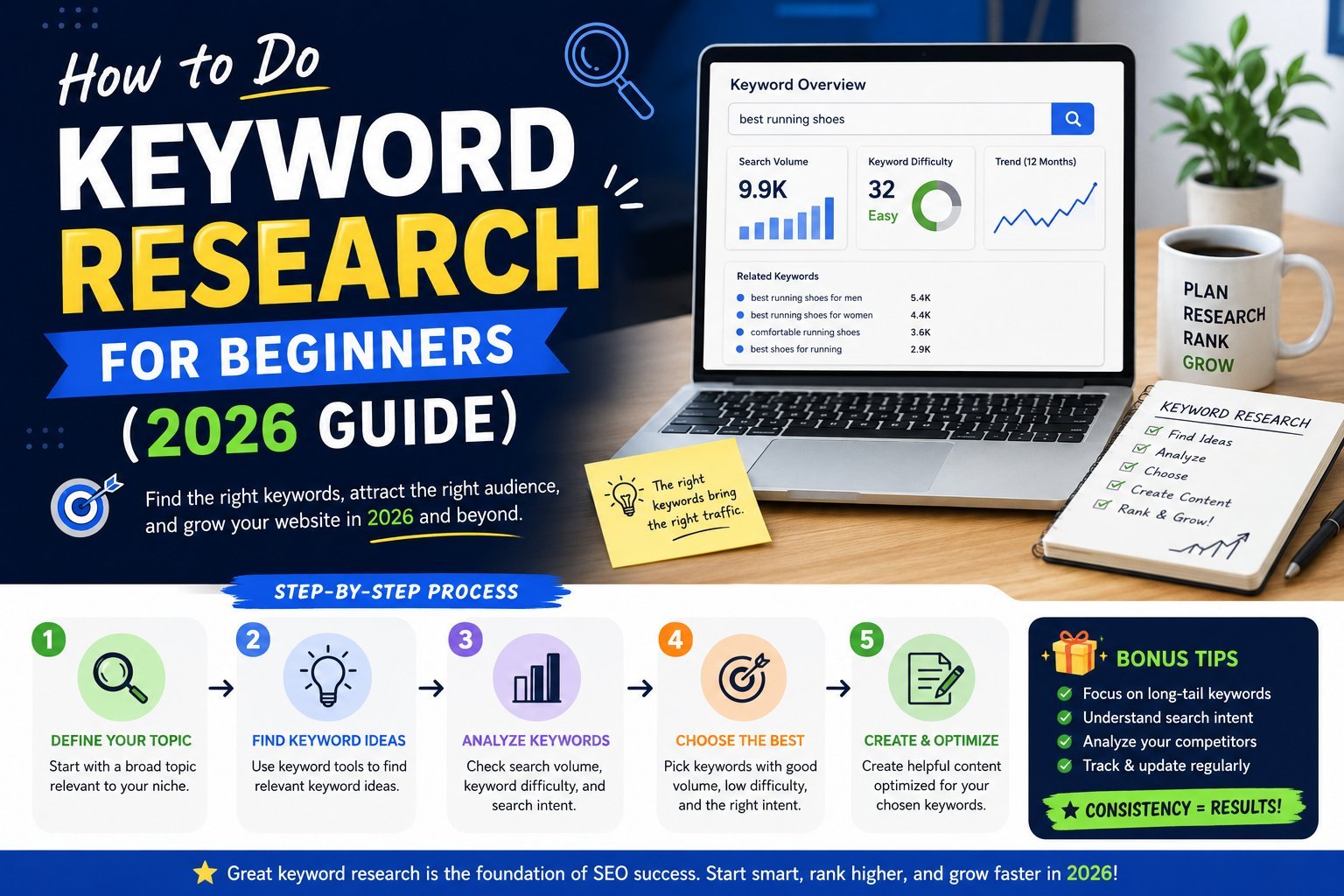
If your website is not getting traffic, the reason is usually very simple:
👉 You are targeting the wrong keywords.
This is one of the most common mistakes beginners make. They spend hours writing content, designing pages, and even promoting their posts on social media — but still see little to no results.
Most beginners fail at SEO for one simple reason: they don't know what people are actually searching for.
You can write the best content in the world, but if you target the wrong keywords, no one will ever find it.
That's why keyword research for beginners is the most important skill you can learn in SEO.
In this guide, you'll discover simple and effective keyword research methods, understand search intent, learn how to find long-tail keywords, and get practical tips to start ranking on Google — even with a brand new website.
Why Keyword Research for Beginners Is So Hard (And How to Fix It)
Because most beginners are guessing instead of using data.
Imagine writing a 2,000-word article that nobody is searching for. No matter how good your content is, it will not rank, and it will not bring visitors. That means your time, effort, and energy go to waste.
On the other hand, if you choose the right keywords, even a simple article can start getting traffic from Google. This is the power of keyword research.
Keyword research is not just about finding words. It's about understanding:
👉 What your audience is searching for
👉 What problems they want to solve
👉 What kind of content Google is already ranking
When you understand this, everything becomes easier:
You know exactly what to write
You attract the right audience
You increase your chances of ranking
In simple words, keyword research is the difference between writing content that gets ignored and creating content that brings organic traffic every day.
In this complete beginner-friendly guide, you'll learn:
What keyword research really means
How to find profitable keywords step by step
How to identify low-competition keywords
How to understand search intent
The best keyword research tools available
How to use tools like Rankivo to speed up everything
By the end of this guide, you won't be guessing anymore. You'll have a clear system to find keywords that actually bring traffic — and potential customers — to your website.
What Is Keyword Research? (And Why Beginners Must Learn It)
Keyword research for beginners starts with one simple idea: find the exact words and phrases people type into search engines like Google.
For example:
"how to lose weight fast"
"best SEO tools for beginners"
"how to start a blog in 2026"
These phrases are called keywords. Your goal is simple: find keywords that people are already searching for, and create content around them. Instead of guessing what to write, you use real data.
When done right, keyword research tells you exactly what your audience wants — before you write a single word.
Why Keyword Research Is Important for SEO
Let's be honest. Without keyword research:
You write content blindly
You guess topics
You waste time
That leads to:
❌ No rankings
❌ No traffic
❌ No growth
With keyword research:
You target real demand
You create relevant content
You attract the right audience
That leads to:
✅ More organic traffic
✅ Better rankings
✅ Higher conversions
Keyword research is not optional — it is the starting point of every successful website. Google uses keywords to understand what your content is about. If you don't target the right keywords, Google cannot match your content to the right searches.
The businesses and bloggers who dominate Google search results are not smarter than you. They just understand keyword research better.
Keyword Research Methods That Actually Work
There are several keyword research methods you can use, but beginners should focus on simple and effective strategies.
Here are the most powerful methods:
Google Autocomplete — start typing a keyword and see what Google suggests
Competitor keyword analysis — find what keywords your competitors are already ranking for
Using keyword research tools — get data on search volume and keyword difficulty instantly
Finding long-tail keywords — target specific phrases with lower competition
These keyword research methods help you discover what people are actually searching for and how competitive those keywords are. The key is to combine multiple methods rather than relying on just one.
Types of Keywords You Must Know
Understanding keyword types will help you choose the right strategy and avoid wasting time on keywords you cannot rank for.
Short-Tail Keywords
Examples: "SEO", "blogging", "fitness"
These keywords have very high search volume but also extremely high competition. They are very hard to rank for, especially for new websites.
👉 Beginners should avoid these.
Long-Tail Keywords (Best for Beginners)
Examples:
"best SEO tools for beginners"
"how to lose weight without gym"
"keyword research for small websites"
Long-tail keywords have lower competition, are easier to rank for, and have clearer search intent. They may bring less traffic individually, but combined they can drive significant organic traffic to your website.
👉 This is where beginners should focus 80% of their effort.
Buyer Intent Keywords
Examples:
"best SEO tools",
"SEO tool pricing",
"Ahrefs alternative"
These users are ready to take action. Buyer intent keywords bring targeted visitors who are more likely to sign up or purchase.
👉 These keywords bring conversions, not just traffic.
Informational Keywords
Examples:
"what is keyword research",
"how does SEO work",
"what is search intent"
These keywords attract people in the learning phase. They are great for building authority and bringing new visitors into your content funnel.
👉 Use these for blog posts and guides.
What Makes a Good Keyword?
Not every keyword is worth targeting. Before choosing a keyword, check these three factors:
Search Volume
Are people actually searching for this? If nobody is searching, you won't get traffic even if you rank number one. Use keyword research tools to check monthly search volume before committing to a topic.
Keyword Difficulty
Can you realistically rank for this keyword? If the top results are major websites with thousands of backlinks, it will be very hard to compete. Look for keywords where smaller websites are already ranking — that is your signal that you have a chance.
Search Intent
What does the user actually want when they search this keyword? This is the most important factor.
Search intent falls into four categories:
Informational — the user wants to learn (e.g. "what is SEO")
Navigational — the user wants a specific site (e.g. "YouTube login")
Commercial — the user is comparing options (e.g. "best SEO tools")
Transactional — the user is ready to buy (e.g. "buy SEO tool subscription")
If your content doesn't match search intent, you won't rank. Even if you do rank temporarily, users will leave immediately — and Google will push you back down.
Step-by-Step Keyword Research Process
Now let's break it down into a simple system you can follow today.
Step 1: Start With a Seed Keyword
A seed keyword is your starting point. Think about your niche and write down 3 to 5 broad topics related to it.
If you run an SEO blog, your seed keywords might be: SEO, keyword research, content writing, backlinks, on-page SEO.
Pick one and move to the next step.
Step 2: Generate Keyword Ideas
Expand your seed keyword into dozens of ideas. You can do this manually using Google Autocomplete, the "People Also Ask" box, and Related Searches at the bottom of the results page.
But this is slow and limited. A faster method is to use a keyword research tool like Rankivo, which generates hundreds of keyword ideas instantly — along with search volume and keyword difficulty data.
Step 3: Focus on Long-Tail Keywords
Instead of targeting "SEO tools" (extremely competitive), go for "best free SEO tools for beginners 2026" (much easier to rank for).
Long-tail keywords are easier to rank for, bring more targeted organic traffic, and convert better because the user knows exactly what they want.
Step 4: Find Low Competition Keywords
This is the most important step for beginners. Look for keywords where:
Smaller websites and blogs are ranking on page one
The content on the first page is weak or outdated
The domains ranking have low authority scores
Example: "keyword research for beginners 2026" is far easier to rank for than "keyword research" — and the people searching it are exactly your audience.
Step 5: Analyze Search Intent
Before writing, search your keyword on Google and study the results. What format are the top articles? Are they lists, guides, comparison posts, or videos?
Match your content format to what Google is already rewarding. This is how you align with search intent and give yourself the best chance of ranking.
Step 6: Analyze Your Competitors
Look at who is ranking on page one for your keyword. Check:
Are they big authority websites or small blogs?
Is the content thorough or thin?
Are there gaps you could fill with better or more updated content?
If you see forums, small blogs, and weak articles on page one — that is your opportunity.
Step 7: Choose Your Keyword and Commit
Pick keywords that are relevant to your niche, have manageable competition, and match clear search intent. Then write the best piece of content on that topic and publish it.
👉 Don't overthink. Take action.
Best Free and Paid Keyword Research Tools
Free Methods
Google Autocomplete — free, instant, shows real searches
Google Trends — shows whether a keyword is growing or declining
People Also Ask — reveals related questions your audience has
Google Search Console — shows which keywords your site already ranks for
These are useful starting points but they are slow and provide limited data.
Paid and Advanced Tools
Paid keyword research tools save time, provide accurate search volume and keyword difficulty data, and help you scale your content strategy much faster.
👉 Rankivo is built specifically for bloggers and content creators who want to:
Find keyword ideas instantly
Identify low-competition keywords with real data
Understand search intent quickly
Generate SEO-optimized content
Save hours of manual keyword research every week
Common Keyword Research Mistakes Beginners Make
Avoid these if you want results:
❌ Targeting high competition keywords — Beginners often go for big keywords and never rank. Start small and build momentum.
❌ Ignoring search intent — If your content doesn't match what the user actually wants, you won't rank no matter how good your writing is.
❌ Writing without research — Guessing topics is the fastest way to waste months of effort. Always validate with data first.
❌ Not using keyword research tools — Manual research using only Google gives you incomplete data. Tools give you the full picture.
❌ No content strategy — Publishing random articles without a plan doesn't work. Use a content cluster strategy to build topical authority.
❌ Targeting only one keyword per article — Each article should target a primary keyword plus several related secondary keywords and LSI terms naturally woven into the content.
Pro Tips to Rank Faster With Keyword Research
🔥 Focus on easy wins first — Build momentum with low-competition, long-tail keywords before going after harder ones.
🔥 Build content clusters — Create one pillar article and 5 to 7 supporting cluster articles around it. Link them together. This builds topical authority and tells Google you are an expert on the subject.
🔥 Use internal linking — Connect your articles to each other. This helps both SEO and user experience, and distributes authority across your site.
🔥 Update content regularly — Google prefers fresh content. Revisit your top articles every 3 to 6 months and update them with new information.
🔥 Target secondary keywords naturally — Include related terms like "search intent", "organic traffic", "keyword difficulty", and "long-tail keywords" naturally throughout your content. This helps Google understand the full context of your article.
🔥 Use tools smartly — Don't do everything manually. Use Rankivo to speed up keyword research and content creation so you can publish more in less time.
Real Example: Keyword Cluster Strategy in Action
Let's say your niche is SEO and your seed keyword is "keyword research."
Instead of writing one generic "SEO guide," you build a cluster:
Pillar article: 👉 How to Do Keyword Research for Beginners (2026 Guide) ← You are here
Supporting cluster articles:
Each cluster article links back to the pillar. The pillar links to all cluster articles. This structure builds authority fast and helps every article in the cluster rank higher.
👉 This is how serious SEO practitioners build traffic — not with random posts, but with a deliberate content strategy.
Conclusion
Keyword research for beginners doesn't have to be complicated.
It comes down to a simple process:
👉 Find what people are actually searching for
👉 Choose keywords you can realistically rank for
👉 Match your content to search intent
👉 Create genuinely helpful content
👉 Build internal links and content clusters
If you do this consistently, your organic traffic will grow, your rankings will improve, and your website will start attracting real users and potential customers.
The difference between websites that grow and websites that stay stuck is almost always keyword research. Start with long-tail keywords, understand search intent, and use the right tools to save time.
FAQs
Q: What is the best keyword strategy for beginners?
👉 Focus on long-tail keywords with low competition and clear search intent. These are easier to rank for and bring more targeted organic traffic.
Q: How many keywords should I target per article?
👉 Focus on one primary keyword, two to three secondary keywords, and several LSI terms naturally placed throughout the content. Use proven keyword research methods to find them.
Q: How long does keyword research take?
👉 Manually: several hours. With tools like Rankivo: minutes.
Q: Can I rank without keyword research?
👉 Very unlikely. Without targeting the right keywords, Google has no clear signal about what your content is about or who it should show it to.
Q: What is search intent and why does it matter?
👉 Search intent is the reason behind a search query. If your content doesn't match what the user actually wants, Google will not rank it — even if it is well written.
Final Verdict
Keyword research is the foundation of SEO. Without it, you are guessing. With it, you have a clear roadmap to organic traffic and growth.
If you want to save time and find keywords that actually rank, use Rankivo to discover low-competition keywords, analyze keyword difficulty, understand search intent, and generate SEO-optimized content — all in one place.
Ready to create content like this?
Use RANKIVO to generate SEO-optimized content in seconds. Start free today.
Start Free — No Credit Card