How Long Should a Blog Post Be for SEO?
Wondering how long your blog posts need to be to rank? Here's what the data says about ideal blog post length for SEO — and when shorter wins.
James Wu
AI & Content Automation · June 27, 2026
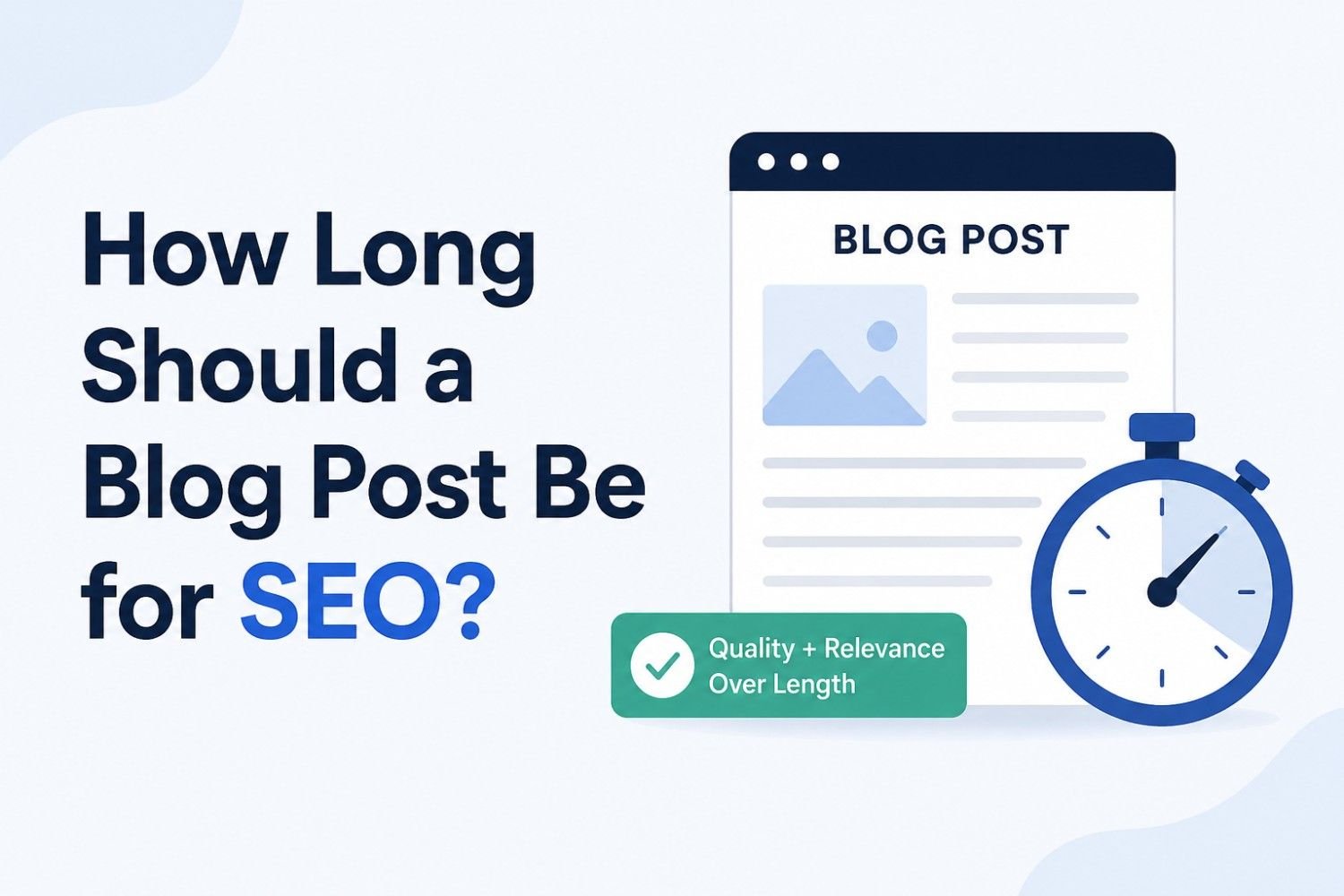
It is one of the most searched questions in content marketing — and one of the most misunderstood.
The short answer: it depends on what the searcher actually needs. But there are clear patterns that tell you when longer content wins and when a tight 600 words will outperform a bloated 3,000-word post.
Here is what you need to know.
Why Word Count Alone Does Not Determine Rankings
Let's get this out of the way first. Google does not rank content based on word count.
There is no minimum length that guarantees a ranking. There is no magic number at which Google flips a switch and decides your post is good enough.
What Google does care about is whether your content satisfies search intent — meaning it gives the searcher exactly what they were looking for, completely and clearly.
Word count is a byproduct of doing that well. Not the goal itself.
So What Does the Data Actually Show?
Studies consistently show that longer content tends to rank higher for competitive, informational queries. Posts in the 1,500–2,500 word range tend to dominate top positions for complex topics.
But those same studies show short content — under 1,000 words — regularly ranks in the top three for specific, narrow questions.
The pattern makes sense when you think about it. If someone searches "how to boil an egg," a 2,500-word post is not better. It is worse. It buries the answer.
If someone searches "complete guide to on-page SEO," a 600-word post is not going to cut it. The topic is too broad.
The Ideal Blog Post Length by Content Type
Here is a practical breakdown based on query type:
✅ Informational guides and tutorials: 1,500–2,500 words — These need to cover the topic fully, answer follow-up questions, and build authority. Thin coverage of a broad topic will lose to a post that goes deeper.
✅ Listicles and roundups: 1,000–2,000 words — Enough to make each item genuinely useful, not just a headline with two sentences beneath it.
✅ Specific how-to posts: 700–1,200 words — Answer the question clearly. Include steps. Don't pad.
✅ Narrow question-based posts: 500–800 words — Posts targeting exact questions ("does meta description affect SEO?") just need a clear, accurate answer. Get in, answer it well, get out.
✅ Product and service pages: 300–700 words — Conversion-focused. Concise wins here.
When Longer Content Hurts Your Rankings
More words do not mean more value. Padding your post to hit a word count target actively damages your content.
Signs your post is padded:
❌ Restating the same point in different words
❌ Long introductions that delay the actual answer
❌ Sections that exist just to add length
❌ Conclusions that summarise what the reader just read, adding nothing new
Search engines have gotten very good at detecting thin content hidden inside long posts. A 2,000-word post where only 800 words actually say something useful is effectively an 800-word post — and a poorly structured one at that.
How to Decide the Right Length for Your Post
The most reliable method: look at what is already ranking.
Search your target keyword. Check the top three to five results. Note their approximate length, structure, and depth. That gives you a real benchmark — not a theoretical one.
Then ask yourself: can I cover this topic better than what is currently ranking? If yes, write the length that lets you do that. Not longer. Not shorter. Just complete.
If writing that content from scratch feels overwhelming, Rankivo's Blog Generator produces full SEO-optimised articles structured around your keyword — with H1–H3 headings, natural keyword placement, and a length calibrated to the topic. It is a fast starting point you can refine and publish.
The Takeaway
How long should a blog post be for SEO? Long enough to fully answer the searcher's question. Short enough to not waste their time.
For most informational posts, that sits between 1,200 and 2,000 words. For narrow questions, 600–800 words is often better. For broad guides, go deeper.
Match the depth to the query. That is the only word count rule that actually matters.
This Article Is Part of Our On-Page SEO Series
📚 Explore the full Keyword Research Series
Start here:
Pillar article:
👉 On-Page SEO for Beginners: The Complete 2026 Guide
Parent cluster article:
👉 How to Optimize Your Blog Content for SEO (Step-by-Step)
Other articles in this group:
How Long Should a Blog Post Be for SEO? ← You are here
Explore the full series to go deeper on any topic.
FAQ
Is there a minimum word count for SEO?
No official minimum exists. Google ranks based on relevance and quality, not length. That said, most competitive informational posts need at least 1,000–1,500 words to cover a topic fully enough to rank.
Do longer blog posts always rank better?
No. Longer posts rank better for broad, complex topics. For narrow queries, a focused 600-word post often outranks a padded 2,500-word one.
What is the ideal blog post length for a beginner blogger?
Start with 800–1,200 words for most posts. Cover the topic clearly, answer the main question, and avoid padding. Quality over length, always.
Does Google penalise short content?
Not for being short. Google can penalise thin content — meaning content that lacks substance or fails to help the reader. A well-written 500-word post beats a hollow 2,000-word one.
How do I know if my post is long enough?
Check what is ranking for your target keyword. Match or exceed the depth of those results. If your post fully answers the question with no gaps, it is likely long enough.
Need a full SEO-optimised blog post without starting from scratch? Rankivo's Blog Generator writes structured, keyword-ready articles in seconds — so you can focus on refining, not drafting. Try it free at rankivo.co.
Written by
James Wu
AI & Content Automation
James explores the intersection of AI and content marketing. He writes about using tools like RANKIVO to produce high-quality, SEO-optimized content at scale.
Ready to create content like this?
Use RANKIVO to generate SEO-optimized content in seconds. Start free today.
Start Free — No Credit Card